
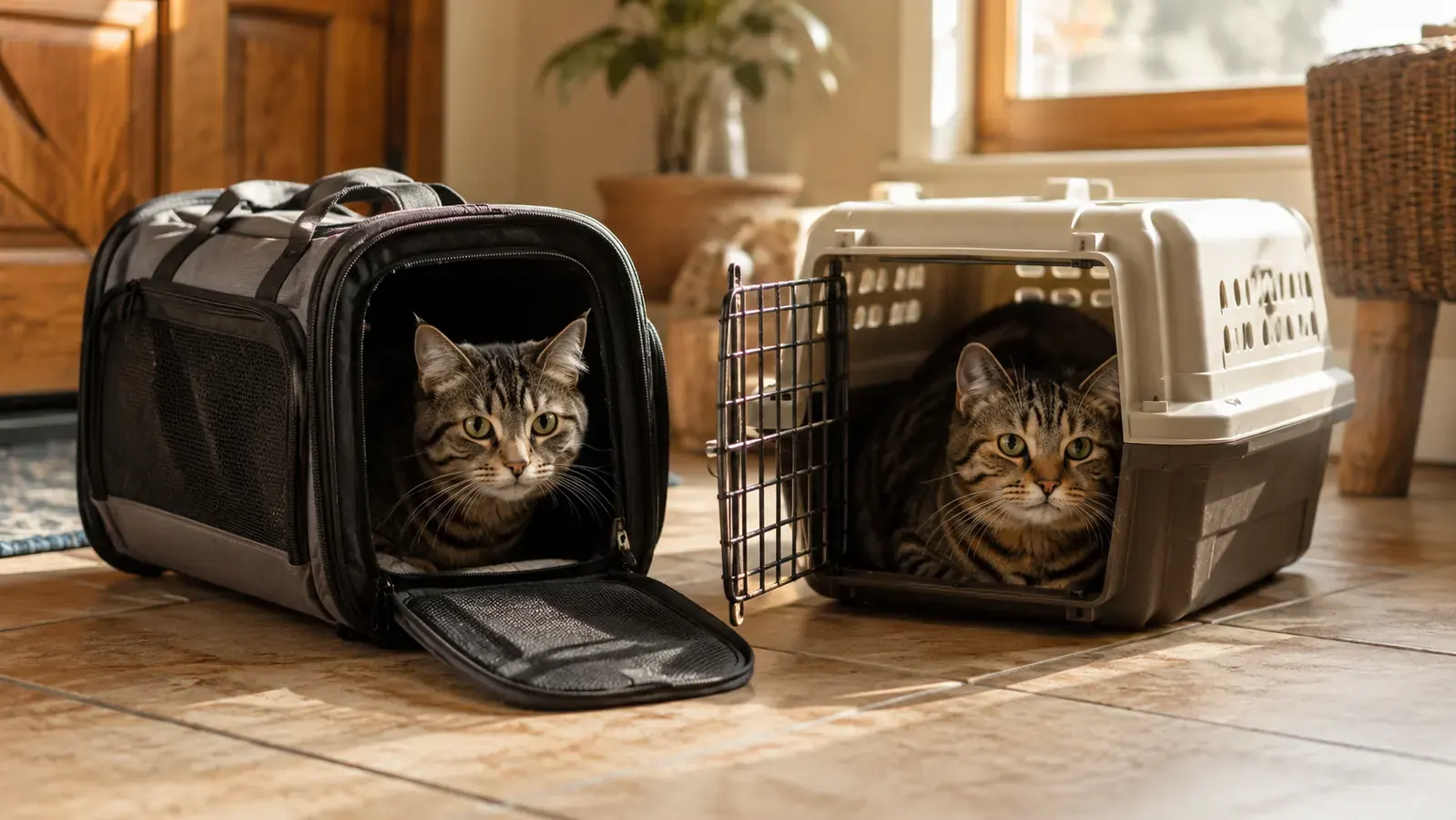
If you grew up with dogs the way I did, you bought your first cat carrier out of habit. A sturdy plastic crate with a wire door, the kind you'd strap on the floorboard of a truck for a hunting trip. That is what I carried my first cat, a skittish tuxedo named Beans, in for years. Then I got a second cat, then a third, and somewhere around the fourth year of hauling ninety pounds of squirming, yowling cat to the vet in that plastic box, I stopped assuming dog logic applied to cats. It does not, and the carrier you choose is one of the first places that shows up.
The short answer, and I'll give you the honest version up front because I hate articles that bury the lead: for everyday veterinary visits, car rides, and any cat under about a dozen pounds, a good soft-sided carrier like the Henkelion is the better buy. The hard crate wins in exactly one important place, crash safety in a car, and it is a non-negotiable for that one use. Your home situation tells you which column you live in. Here is the full breakdown, including a few things I had to learn the hard way with three very different cats.
| Soft-Sided Cat Carrier | Hard Crate | |
|---|---|---|
| Price | Usually the cheaper buy (check today's price) | Usually the pricier option (check today's price) |
| Weight | Light, roughly 3 lbs | Heavy, 8 lbs or more |
| Cat comfort | Gives under pressure, cats curl in more | Rigid and roomy, but a hard floor |
| Cleaning | Padded liner comes out, wipe the lining | Hose the whole crate out in the yard |
| Airline use | Many are airline-approved, light to carry | Some meet airline rules, heavy to lug |
| Storage when empty | Collapses flat or nearly flat | Bulky, claims closet or garage space |
| Carrying | Shoulder strap leaves a hand free | Two-hand carry, always awkward |
| Crash safety in a car | Soft, not crash-tested | Rigid shell offers more impact protection |
| Escape risk | Can flex if a cat works a zipper | Rigid, much harder to force open |
| Best for | Everyday vet trips, travel, nervous cats | Car transport, big or escape-prone cats |
Most homes want the soft-sided one
For the vet runs, the road trips, and the cats who would rather be a pancake than a prisoner, the Henkelion soft carrier is the one I reach for. It is light enough to carry one-handed with a cat inside, and it folds flat when you are not using it.
Amazon Check Today's Price on Amazon →Where the Soft-Sided Carrier Wins
The biggest thing nobody warns you about with a hard crate is that cats hate being swung around in a hollow, echoing box. My cat Beans would howl nonstop for the whole drive in the plastic crate, not because she was scared of the vet but because every turn made her slide and every bump echoed off the walls. The first time I put her in a soft-sided Henkelion, she went quiet in about four minutes. The fabric gives a little, so she could brace herself against the sides the way a cat wedges itself into a cardboard box, which is their favorite thing in the world.
Weight is the other silent win. A dozen-pound cat in a three-pound soft carrier is nothing to carry. In the hard crate, you are hauling twenty-plus pounds up stairwells and across parking lots. I am not a large woman, and my back noticed the difference on the very first trip. And because the soft carrier collapses flat, it lives in a hall closet instead of taking up half my garage. For three cats I keep two of them stacked flat and pull one out whenever anybody needs the vet. The dog-style instinct says hard equals safe, but most of your week is about convenience, and the soft one wins that fight easily.
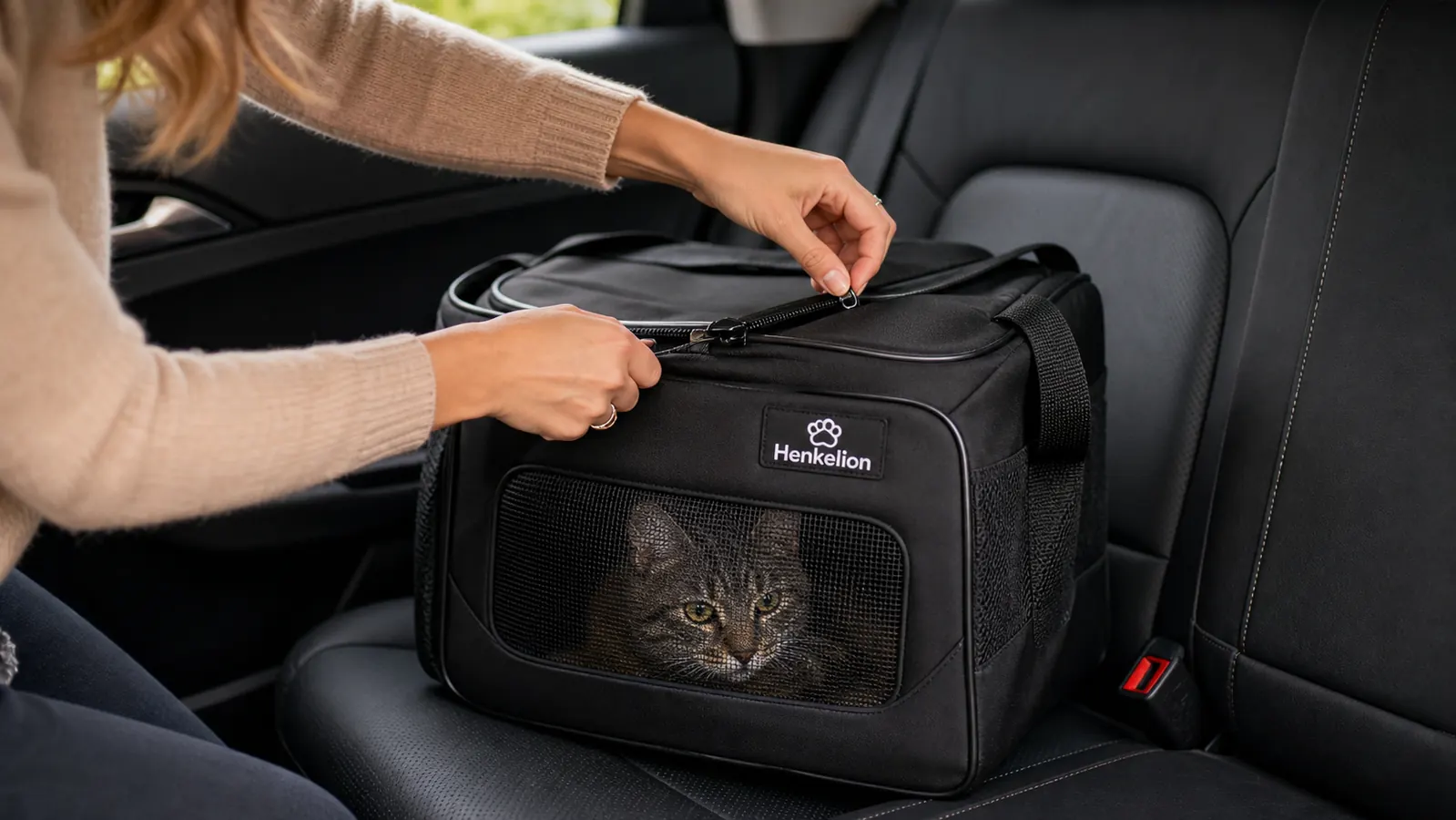
Then there is the mesh window. Cats are nose-first creatures, and the soft carriers have mesh panels on almost every side, so mine can see out. Beans is calmer watching the world go by than she ever was staring at the inside of a beige box. The Henkelion is rated up to fifteen pounds, so even a hefty cat has room to turn around, and the waterproof lining wipes clean with a damp rag. That is a detail dog people never think to ask about, and it is the one that saves you from a ruined back seat on a bad travel day.
Temperature is a comparison people never think to run until they live it. A hard crate turns into a little greenhouse on a hot summer vet run, stale air and body heat piling up inside a sealed plastic shell, while the soft carrier's mesh sides let air move through even with the top closed. On the cold end of the year, the soft walls hold a little warmth close to your cat instead of radiating it away the way hard plastic does. Neither one is a climate control system, and you still adjust the heat and keep the carrier out of direct sun. But when I put a nervous cat in a soft carrier on a ninety-degree day, I know she is breathing moving air, and that small thing has kept more than one drive from turning into a panting, overheated mess.
The first time I put Beans in a soft-sided carrier, she went quiet in about four minutes. It was the first silent vet trip I'd had with that cat in her whole life.
Where the Hard Crate Wins
I said the hard crate wins in one place and I meant it, but that place matters: crash safety in a car. If your cat rides in the car seriously, the way a traveling cat or a cat with a chronic condition that needs regular specialist visits does, then a rigid crate secured with a seat belt is the safer choice. Soft carriers are not crash-tested, and in a sudden stop a soft bag gives nothing to distribute the force across your cat's body. That is a real consideration, not an imagined one, and I do not want a soft-carrier owner to read this article thinking it does not apply to them.
The hard crate is also the answer for a big cat or a cat determined to escape. My third cat, a brick of a ginger tom named Mabel who pushed twenty pounds, could flex the top of a soft carrier enough to worry me. He never got one open, but the hard crate has walls that do not give and a wire door that locks back solidly. For a large or escape-inclined cat, that rigidity is worth the extra weight. And for cleaning after a truly nasty accident, nothing beats taking a hard crate into the backyard and hosing it out, something you cannot do with fabric, padding, and Velcro.
There is also the matter of what a carrier is carrying beyond the cat. A hard crate with a smooth interior floor is far easier to clean when something goes genuinely wrong on a long drive, because you can tip the whole thing over a drain and flush it out. A soft carrier's liner has to come out and go through the wash, and the padding underneath can hold a smell long after you think you have handled it. I keep a spare towel tucked in mine either way. But if your cat is car-sick on the regular, the hard crate's seamless plastic is the friendlier choice for your nose and your sanity, and that is a trade that counts for more than the shin-thumping on the way to the door.
Still on the fence? The soft one handles 9 of 10 jobs
If your cat is average-sized and your drives are ordinary, the soft-sided Henkelion covers the vet runs, the boarding trips, and the emergency kit, and it folds away when the job is done. That is the trade I made, and I have not regretted it.
Amazon See the Henkelion Soft Carrier on Amazon →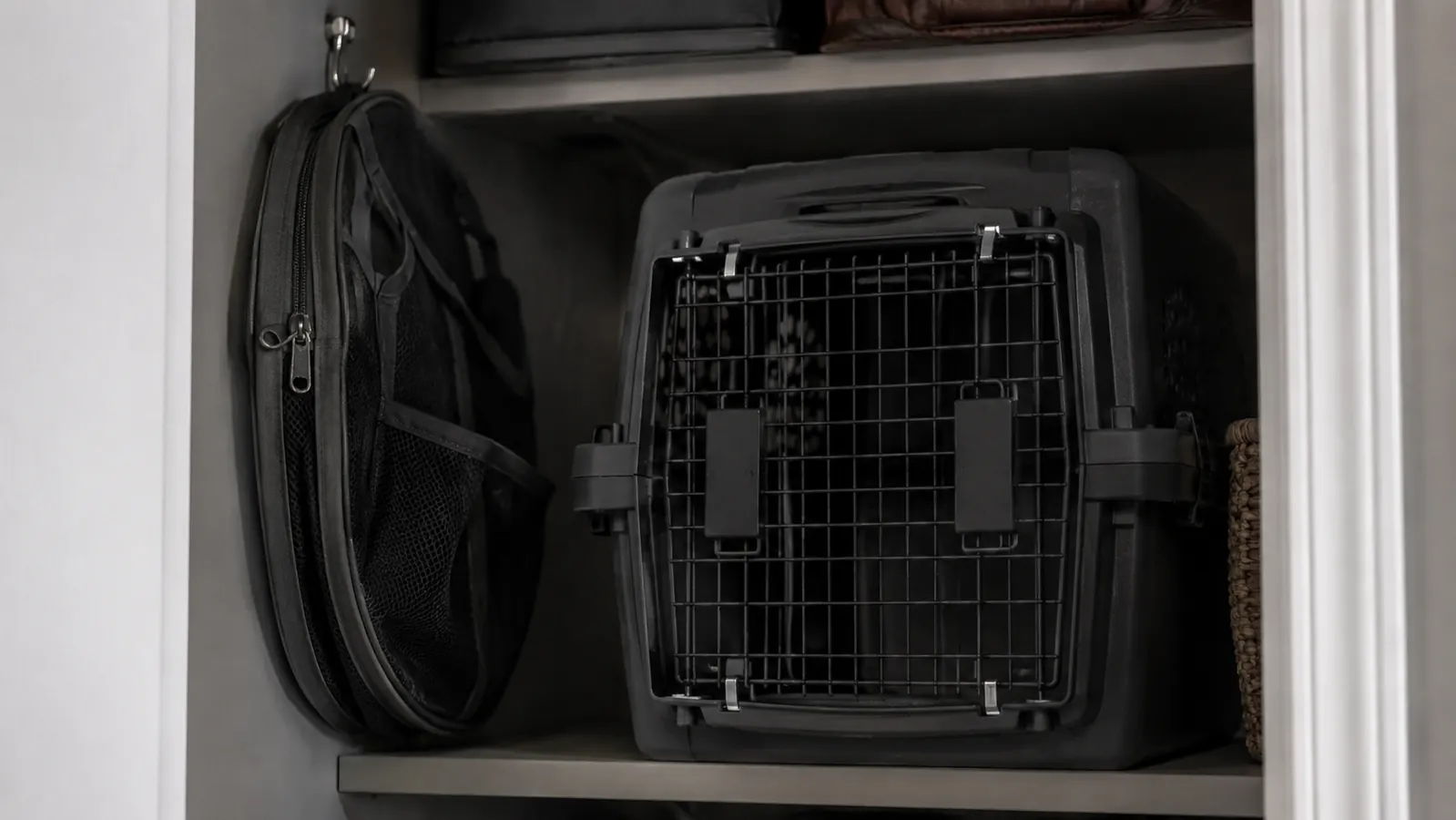
The Details Nobody Mentions Until You Own Both
The should-have-bought-this-sooner moment for me was the shoulder strap. A soft carrier clips onto your shoulder, which leaves both hands free for keys, the door, the second carrier, or a small child. A hard crate has to be carried with both arms in a grip that is never comfortable no matter how you arrange it, and it thumps against your shins on every staircase. When you are managing three cats and a full car, that free hand is not a luxury, it is the whole difference between a smooth morning and a chaotic one.
Airline travel is the other thing people get wrong. If you fly with your cat, measure the carrier against your airline's specific under-seat dimensions rather than trusting the words TSA approved printed on the label. A soft carrier can be gently compressed to fit a slightly snug space, which is exactly why nearly all cabin cats travel in soft carriers. A hard crate that is too big for the seat simply does not board. So if flying is ever in your cat's future, the soft carrier is far easier to work with, as long as you actually check the numbers first.
One honest warning: soft carriers have zippers, and a determined cat will test them. The Henkelion has two zipper pulls per door that meet in the middle, and the trick is to clip those two pulls together with a small carabiner so a cat cannot nose them apart. Mabel spent a full week trying to solve mine before he gave up. That is ten minutes of setup that turns an escape risk into a locked carrier, and it is worth doing before your first real trip, not after a cat bolts in a parking lot.
One more detail that quietly sold me: the way the vet gets your cat out. Many soft carriers open from the top, so the vet unzips the roof and lifts your cat up and out on its own instead of reaching straight into the front door and grabbing at it. Cats hate being reached for head-on, and an anxious cat is far easier to handle from above. The hard crate opens from the front only, so whoever extracts your cat has to go through the doorway. That small difference has made more than one visit calmer for Beans, and the techs at my clinic say they can usually tell which cats came in soft carriers before they even look at the chart.
Take the strap seriously too. The Henkelion's strap is padded and wide enough to sit on a shoulder without sawing into it, and once you have carried a cat for ten minutes from a far parking spot, you understand why people describe the hard crate carry as the toll you pay for its safety. For a nervous or heavy cat you are often holding the carrier close to your chest with one hand underneath it, the way you would settle a baby. That is easy with a soft shell. A hard crate has no give, so there is no comfortable way to do it.
Who Should Buy Which
Buy the soft-sided carrier if your cat is under about a dozen pounds, your trips are regular but ordinary (vet visits, boarding, the occasional road trip), and you are the one carrying it. It is lighter, cheaper, more comfortable for a nervous cat, and it stores flat. That covers the vast majority of cat households, including mine. It is also the right answer if your cat panics in a hard crate, because the soft walls read as safer to them, and a calmer cat means a safer ride for everyone in the car.
Buy the hard crate if your cat is large, unusually strong, or escape-prone, if you travel a lot on highways and want crash-tested protection, or if you are the sort who likes to hose the carrier out in the yard. And if you are honest with yourself and have room in the budget, the best setup is one of each: the hard crate for serious car travel with a secured seat belt, and a soft carrier for the everyday vet run where nobody wants to haul a plastic box through a parking lot.
My own answer changed with my third cat. The Henkelion handles Beans and the middle cat fine, and when Mabel needs the vet he rides in the hard crate. They are not rivals; they are different tools for different days, the way a sturdy Dutch oven and a light frying pan both live in my kitchen and both earn their cabinet space. You are not choosing the one true carrier for your cat's whole life. You are choosing what gets you from Tuesday to the vet and back without a fight, and for most of us, that is the soft one.
Where to start if you only buy one
If you are buying just one to cover most of life, start with the Henkelion soft-sided carrier. It is the one I reach for on an average Tuesday, and it is a fair price for what it does. Keep the hard crate in mind for the serious car trips, and add it later if travel becomes a real part of your cat's life.
Amazon Check Today's Price on Amazon →