
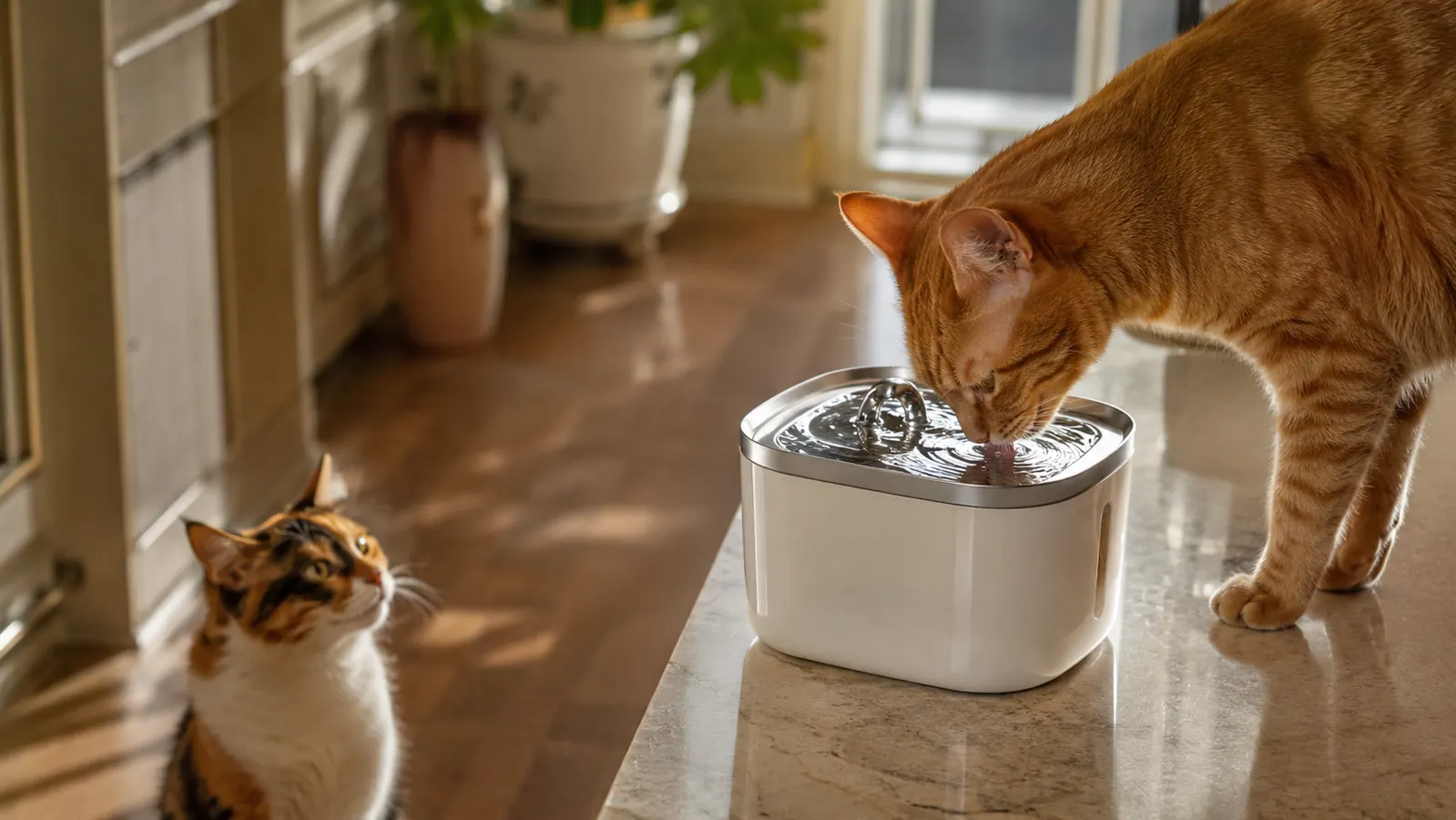
When my veterinarian looked at Penny's chart last spring and asked whether she was actually drinking, I had to be honest that I didn't know. Not for certain. I filled a ceramic bowl every morning and most of it sat there while Penny dozed on the back of the couch like a cat who had solved water. She is a 12-year-old tuxedo, about seven pounds on a heavy day, and the words 'kidney concerns' have a way of focusing a person. Before I bought the Wonder Creature fountain I had tried a second bowl, moved her water away from her food, and stood at the sink running the tap hoping she would drink. She sometimes did, from the tap. Never from the bowl.
That tap habit is what led me here, six months later, writing about a small machine that sits on my kitchen counter and gets visited, batted, and drank from more than I expected by all three of my cats. Let me be clear before the praise starts: a fountain will not fix a cat with a medical reason not to drink. It is not a treatment. But for the common, maddening case where a healthy cat simply snubs still water, it worked in our house. This is what that actually looks like across six months of daily use, with no skimming over the unpleasant parts.
The Quick Verdict
A practical, affordable fountain that got all three of my cats drinking more within ten days, as long as you accept the weekly cleaning it asks for.
Amazon Check Today's Price →The Fountain That Finally Got My Cats Off the Tap
Six months of daily use and I still reach for this one first whenever a cat will not drink from a bowl. The Wonder Creature holds a big reservoir, runs quiet, and keeps the water moving. Check today's price on Amazon and see if it has a spot on your counter.
Amazon Check Today's Price on Amazon →How I've Used It
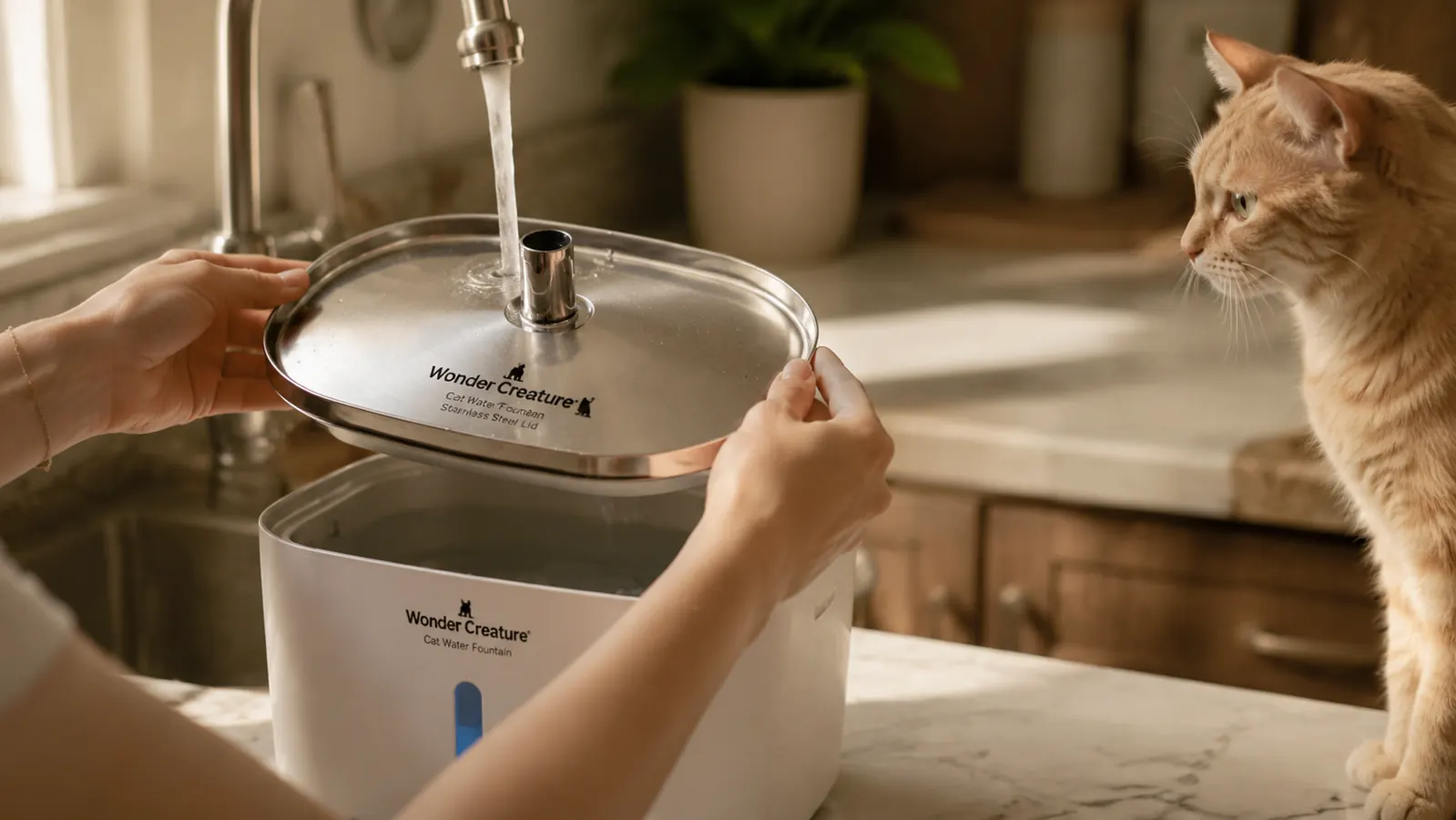
The unit holds 81 ounces, which with three cats means a full reservoir and a top-up every few days rather than a daily chore. Assembly took about ten minutes: reservoir, carbon filter, pump, filter mat, stainless steel top. The LED window on the side shows the water level, which sounds like a small thing until you have owned a fountain you cannot see into and have run the pump dry at 11 at night.
Our household has Penny the tuxedo, Juno the five-year-old orange tabby who believes he is in charge, and Biscuit the three-year-old calico who is mostly here for the splashing. Coming from a house where dogs drank from a bowl at the back door without ceremony, I had to learn that cats treat water as a project. Juno will not drink if his water sits within six feet of his food. With a dog you would never know this matters. With a cat it is half the battle.
The Wonder Creature is not a fancy ceramic piece, and that is fine with me. It is a practical fountain with a plastic reservoir and a stainless steel top, priced well under the ceramic models, and it carries over fifty thousand Amazon reviews at a 4.4 average. That combination, an honest price and a big install base, is why it earned a long-term test in our kitchen instead of a weekend.
The First Month: Did They Actually Drink More?
The short answer is yes, and faster than I expected. By day ten Penny was kneeling at the fountain three or four times a day. Eleven years of barely touching a bowl, and a moving stream snapped something in her brain. Moving water reads as fresh water to a cat, and fresh water is what their instincts tell them to look for. A bowl can taste like the room by afternoon. This is the long-run version of the comparison I keep making between a fountain and a plain bowl, and six months has not changed my mind about it.
Biscuit spent the first week patting the stream with her paw more than drinking it, which is normal cat behavior and not a defect. Juno ignored the whole thing until I moved the fountain from the eating corner into the hallway. Cats carry a hard instinct against drinking near their food, leftover caution from wild ancestors who knew a kill poisons the water nearby. If you take one placement rule from this whole review, take this one: water away from food, even when it feels backwards. It is the first thing I gently correct with dog people, because a dog will happily slurp next to his kibble and nobody thinks twice.
The biology explains the behavior. Cats come from desert ancestors with a naturally low thirst drive, built to get their fluid from prey rather than from a water hole, so they simply do not feel the urge a dog does. A bowl filled and left is fighting millions of years of programming. A dog owner, and I say this as one, expects a pet to drink when it is thirsty. A cat expects someone to put in the work of making the water worth drinking. It is a different deal entirely, and the fountain is the first thing that treated it that way.
Penny went from sipping a bowl maybe twice a week to kneeling at the fountain three or four times a day, and the change happened inside the first ten days.
Six Months In: Noise, Cleaning, and the Pump
The thing nobody puts on the box is that a fountain is a small appliance with a motor, and a motor needs upkeep. The pump is genuinely quiet out of the box. Quiet enough that the first two weeks I kept checking that it was actually running. Then, around month four, it started a low clicking when it ran. That sound is the classic sign of grit in the pump rotor. Fifteen minutes with a full disassembly, a rinse of the impeller, and it was back to silent. No parts to replace, just the fifteen minutes.
The cleaning routine I landed on: once a week I take the whole thing apart, wash the reservoir and the stainless steel top in warm soapy water, and rinse the filter mat and the pump. The filter itself I change every three weeks with three cats. The box says every two weeks, which is conservative, and the carbon turning tea-colored is the real cue. There is no shortcut here. An unkept fountain grows a film that no cat with functioning instincts wants to drink from, and a fountain your cat avoids is a bowl with extra steps. I keep a dedicated bottle brush on the faucet so the deep clean stays twenty minutes instead of forty.
The 81-ounce reservoir is the feature I did not expect to care about. With a smaller model I would have been filling it daily. As it is I top it up a few times a week and do one proper deep clean on the weekend, the same way I set a Sunday loaf to rise. Routine is the whole secret, which is a sentence I never thought I would say about a water bowl.
One setup note I want to be honest about: I did not retire the water bowls. I keep a backup bowl in a quiet corner of the bedroom, because with three cats a single water point is a single point of failure, and because the fountain is out of commission for half an hour on cleaning day. A cat who snubs a bowl will sometimes still visit one in a quiet room when the fountain is down. That backup is cheap insurance, and it lets the fountain be the star without being the only source in the house.
The Six-Month Mark: Filter Swaps and Normal Wear
By month six the routine had stopped being a routine and started being a habit, which is the only honest test of a household machine. The filter still gets changed on the first of the month, and I write the date on the foam mat with a marker so I cannot fool myself into running a carbon pad past its useful life. Around the three-week mark the carbon picks up a faint fish-tank smell, and that smell is the cue, not the calendar. With the three filters that shipped with the fountain now acting as spares, the swap takes about a minute, and I rinse the reservoir with a splash of vinegar during the change the way I deglaze a baking dish.
On wear, six months has been kinder to the Wonder Creature than I expected. The steel lid still looks close to new, with no pitting along the fill line where the water level rests against it, and the plastic reservoir has not scratched or clouded despite the weekly soapy wash. The one part that shows its age is the pump. I have taken it apart twice now to clear grit, and the plastic impeller is the soft spot: one of the three vanes has a small chip, but the pump still runs silent and pulls water without trouble, so I call that normal wear rather than a defect. It is also the only part I would buy preemptively, and for what this fountain costs I will treat that as a reasonable maintenance item, not a repair bill.
The Stainless Steel Top, and the Plastic Question
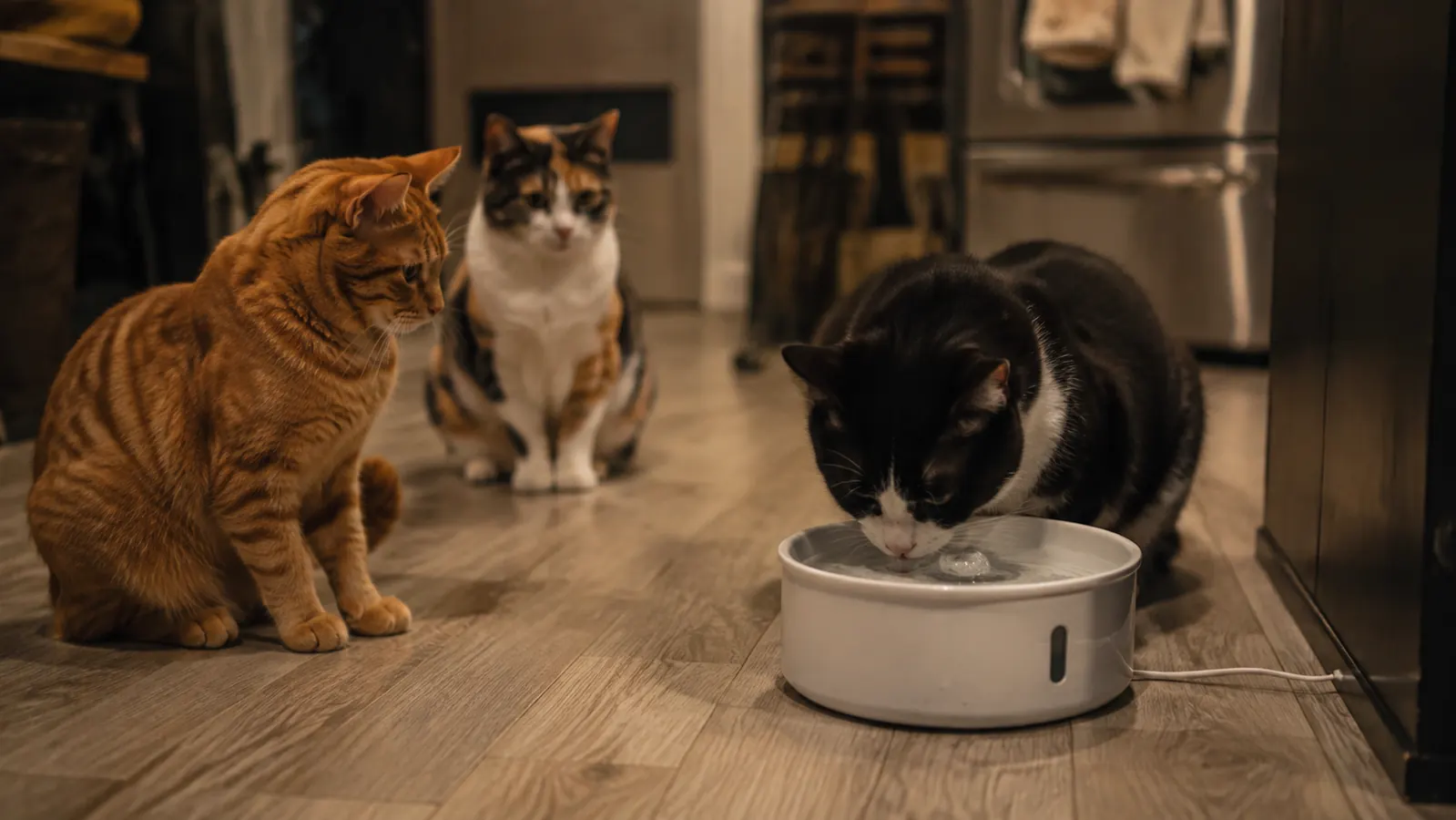
Cats are particular about what touches their whiskers. A narrow dish drives them away because the whiskers brush the sides, and a startled cat remembers that dish. The stainless steel top here is wide and open, so whiskers stay loose, and stainless runs cooler and picks up less odor than plastic. For something that lives on a counter next to your coffee, that matters.
The honest catch is that the reservoir is plastic. Fully stainless fountains exist and they cost noticeably more, and if you are the kind of person who prefers to keep plastic away from food and drink entirely, this model is a hybrid and you should know that going in. For us, the surface the water actually pours over is steel, the plastic never touches the stream the cats drink from, and the trade-off was worth what we saved.
The fountain ships with three carbon filters plus a filter mat, and after those the filter is a consumable you will reorder. It is cheap enough that I do not think about it, but it is a line item. Pretending otherwise is how households end up running a fountain that stopped filtering months ago, and cats, of course, know.
Alternatives I Considered Before Settling
I looked hard at a ceramic fountain from a designer brand before I committed to this one. It was beautiful, it would have matched the kitchen, and it carried the kind of price tag that made me read the fine print twice. The catch was capacity: most of those hold half of what the Wonder Creature holds, and with three cats I would have been filling it every day and hauling a heavier, more fragile piece to the sink.
I also weighed a fully stainless unit to avoid plastic altogether. The ones that are fully stainless run well above today's price for this fountain, and for the difference I can buy filters for a long time. Start with your capacity and your cleaning tolerance before you compare brand against brand, because those two drive the everyday experience more than the logo or the color.
One more comparison worth naming: I looked at a plain raised bowl with a small pump attachment before I settled on a full fountain. It was cheaper, but it sat lower, put the motor inline with the water, and gave me none of the capacity or the filtration a real fountain does. For me the price difference favors a purpose-built unit, because a half solution is how you end up buying the full one anyway.
What I Liked
- All three cats genuinely drank more within the first two weeks, not just for show
- 81-ounce reservoir means a top-up every few days instead of a daily chore
- Stainless steel top cleans up easier and stays cooler than all-plastic models
- Quiet pump out of the box, and when it grumbles a rinse fixes it
- Ships with three carbon filters and a mat, so the early months cost nothing extra
Where It Falls Short
- Weekly cleaning is non-negotiable or the fountain gets a film you will regret
- Reservoir is plastic, so this is not the pick for a no-plastic household
- Pump needs a rotor rinse every few months once grit builds up
- It takes counter space and a cord, and it runs silent only until the next cleaning
- Filters become a recurring order once the three included ones run out
Who This Is For
A fountain like this is for a household with a cat who snubs still water, and especially for the older cats who are the ones veterinarians quietly worry about. It is also for multi-cat homes where a single bowl either gets fought over or ignored, because a big reservoir of moving water settles both problems at once. And if your cat is the tap cat, the one who only drinks running water, the Wonder Creature is the humane replacement for you standing at the sink every evening.
Who Should Skip It
Skip the fountain if your cat already drinks well from a bowl and you do not want another countertop machine to manage. Skip it if the plastic reservoir is a dealbreaker for you, and skip it if you know you will not keep up the weekly cleaning, because a neglected fountain is worse than a clean bowl. And if your cat has stopped drinking entirely, do not buy this first. Call your veterinarian. That is a medical symptom, not a product problem, and no pump on earth fixes it.
Six Months In, It Is Still Doing the Job
The short verdict from our house: three cats, one fountain, more water drunk, and a routine I can live with. If your cat is the tap cat, the bowl snubber, or just older and quiet, this is the one I would start with. Check today's price on Amazon while you weigh it against your counterspace.
Amazon Check Today's Price on Amazon →