
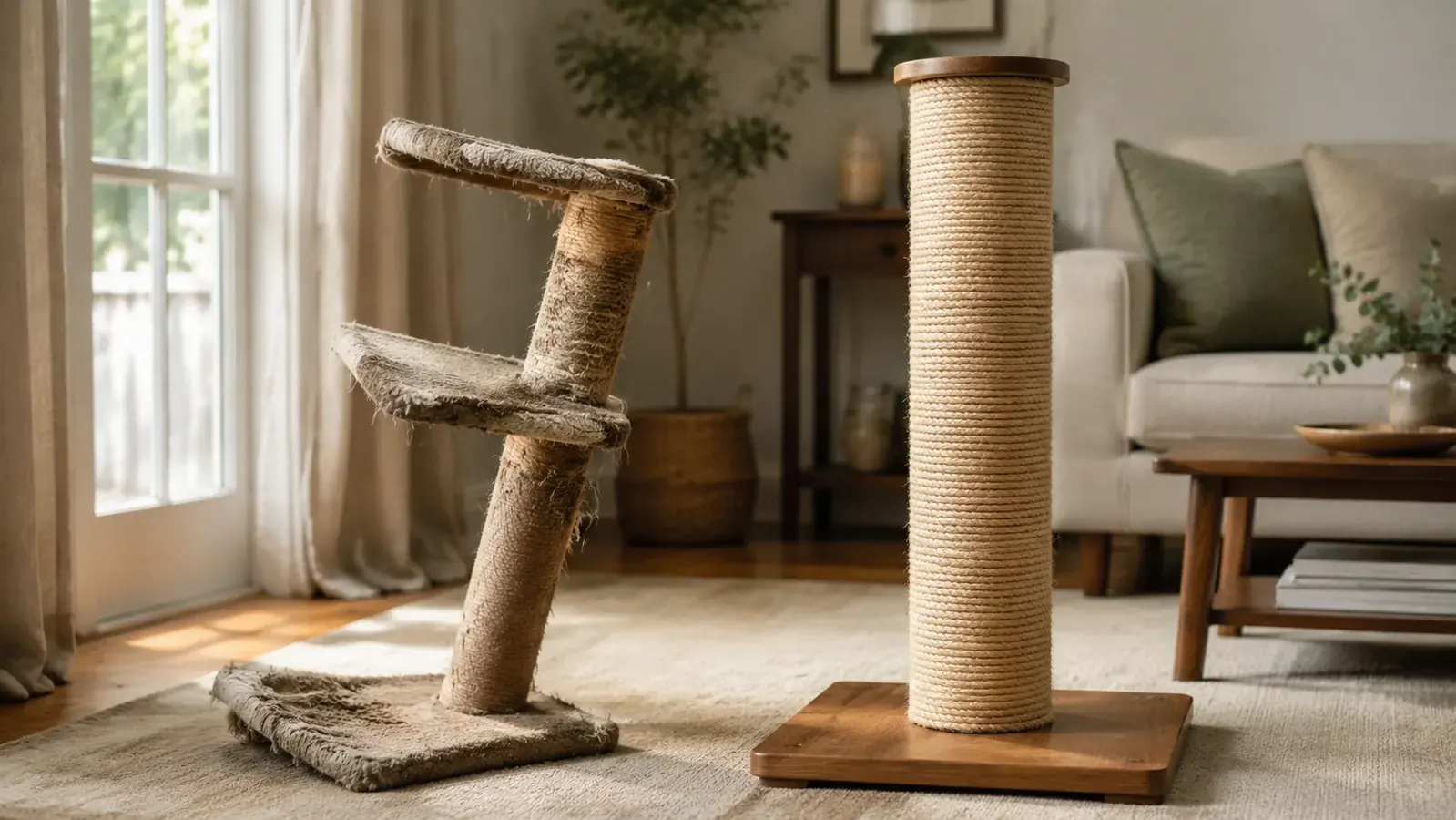
Let me start with the sentence I wish someone had said to me years ago: a scratching post is the one cat purchase where the cheap one will cost you more in the end, and not in the way you think. I did not learn this gracefully. I have owned four scratching posts in my adult life, and the first three, all of them cheap carpet-covered towers, tipped over so often that my orange tabby Juno started treating them like a demolition project. He would hook his claws in, lean his whole thirteen pounds back, and pull the entire tower over onto the floor, not because he was being difficult, but because that is literally what the design asked him to do. The fourth, a SmartCat post on a heavy solid wood base, has never once moved in six months, and that is how I ended up reviewing the real difference between the flimsy ones and the sturdy ones. I grew up with dogs, so my instincts said to scold Juno instead. What he needed was a post that could not be pulled over, and those are not the same conversation.
This honest review is not a love letter. It is the checklist I built the hard way, about what actually separates a sturdy scratching post from a wobbly one, so you do not have to meet the flimsy ones the way I did. I use the SmartCat Ultimate Scratching Post, a 32-inch natural sisal column on a heavy solid wood base, as the sturdy reference point, because after six months with three cats of three very different temperaments, it is the first post I have owned that never once moved. But I am going to tell you what to look for before you buy any post at all, including the reasons a person might still walk away from this one.
The Quick Verdict
A genuinely stable post with real sisal instead of carpet, which is why all three of my cats actually use it and why the couch finally got left alone. Deducting points only because a bare wood base and a single column will not be the right fit for every home.
Amazon Check Today's Price →The Sturdy Post That Survived Three Cats and a Rental
If a cheap tower has already tipped over in your living room once this month, you do not need a bigger tower, you need a heavier base and real sisal. The SmartCat post is the sturdy reference I keep coming back to. Check today's price on Amazon and see whether it is the fix your corner has been waiting for.
Amazon Check Today's Price on Amazon →How I Tested It
I did not run a lab. I ran a living room, which is the only lab that matters. I cleared out every other scratcher we owned, put the SmartCat in the corner next to the couch where all three cats already stretched, and I left the rest of the house exactly the way it was for a full month. That is the part people skip. If you change the post and the furniture and the placement all at once and the couch survives, you have learned nothing about the post. I wanted to know which single variable saved the furniture, so I only changed the one.
My test subjects will not confirm to your schedule. Juno, the five-year-old orange tabby who runs things, puts his whole weight into a stretch and attacks it at full speed. Biscuit, the three-year-old calico, scratches politely and sparingly. And Penny, our eleven-year-old tuxedo, is the tough grader: she distrusts everything new for at least a week, and she only adopts objects that genuinely earn her. If you want real data on a scratching post, you need one skeptic in the house, and Penny is ours. In six months, all three of them use the same post, which is the part I still find unusual.
I also did the boring test that most reviews skip. I pressed on the top of the post with my full weight, I shoved it sideways with the flat of my hand, and I let Juno launch onto it after a closed door closed in his face. The post did not lean, did not slide on the hardwood, and did not so much as rock. That stands against a history of my old posts tilting on the first Tuesday I owned them.
Why the Flimsy Ones Fail: It's the Base, Not the Rope
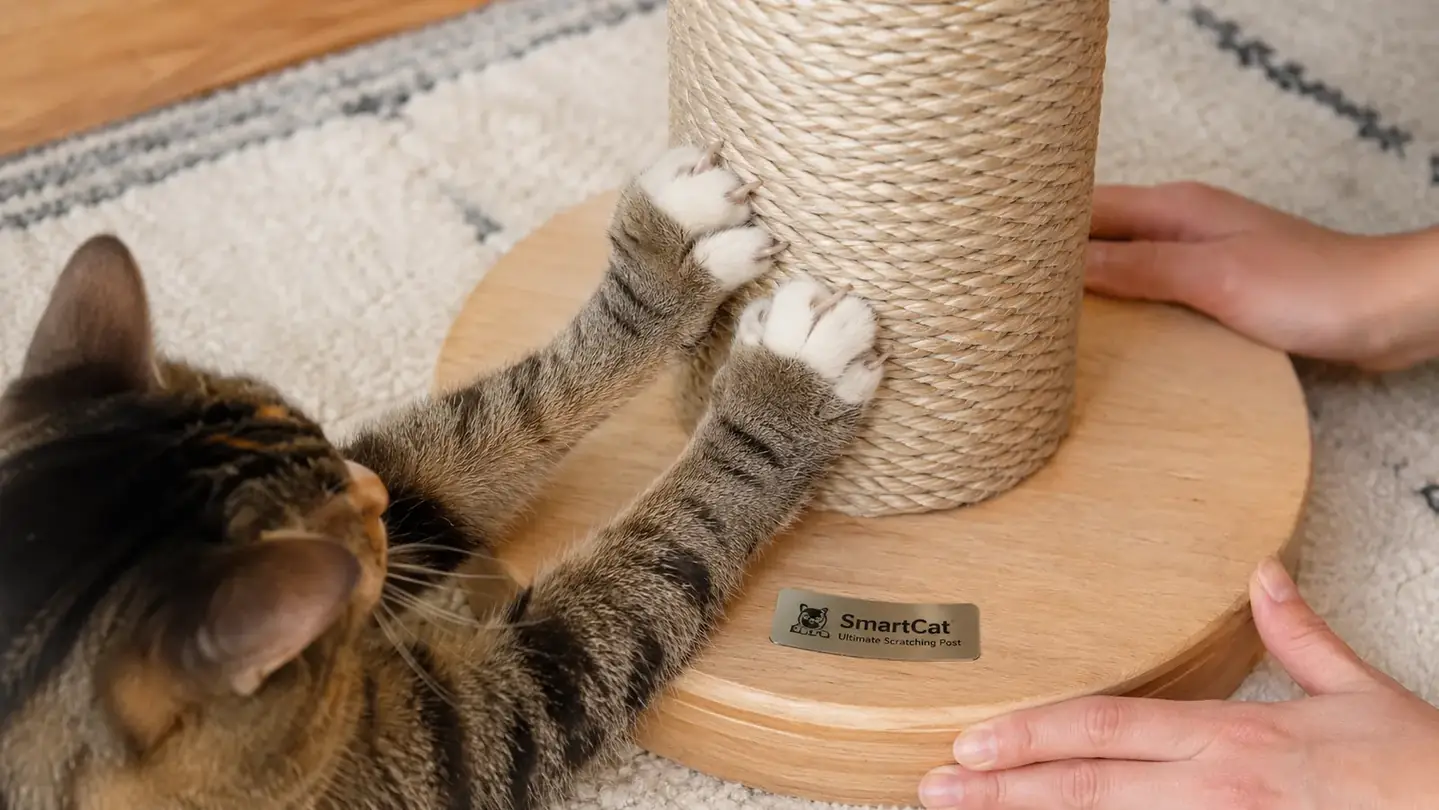
Here is the thing nobody tells you at the register: a cat does not scratch a post, it pulls on a post. The whole motion is load-bearing. Your cat hooks its claws into the rope, leans its weight back, and stretches every muscle from shoulder to paw. That motion shoves the top of the post away from the cat and puts a heavy, repeated downward-and-sideways force on whatever the post stands on. A post built on a thin round cardboard or particleboard base is doing that physics with the wrong foundation, and it is only a matter of time before it goes over.
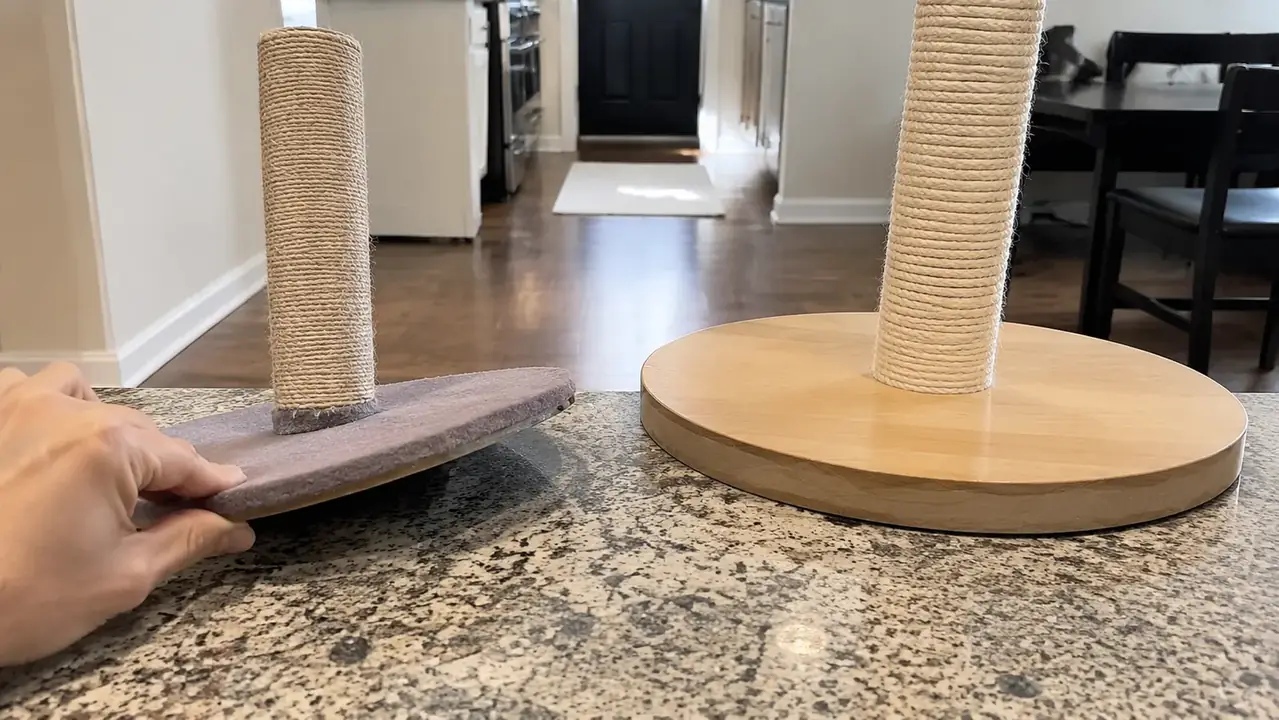
The sturdy fix is blunt and unglamorous: make the base heavy and make it wide, so the force of the pull has nowhere to move it. The SmartCat does this with one solid slab of natural wood. It is not decorative, it is structural. That weight is the whole reason my old posts tipped and this one does not. I can grab the top of the SmartCat and shake it hard and the base stays flat on the floor, which is something I could never honestly say about the towers I used to buy. If you pick up a post in the store and the base feels light, that is not a feature you are holding, that is the defect staring at you.
There is a second, quieter failure mode that even a heavy base will not fix: a wobble. Some posts use a screw-in or friction-fit connection between column and base that loosens over a few weeks of use. The post starts to shimmy, the cat loses trust in it, and the couch wins by default. A post that is honest will have a base and column that feel like one piece from day one and stay that way. That solidity is why all three of my cats commit to the SmartCat the way they do, because they can feel that it will hold them, and cats do not spend effort on objects they do not trust.
What 'Sisal' Actually Means, and Why Carpet Fooled Me
The material is the second half of the sturdy-versus-flimsy story, and this is where I made my most expensive mistake. My first three posts were carpet-covered, and I reasoned that a carpet post was basically a couch you could scratch, so what was not to love. The irony is that this is precisely the problem. To a cat, a carpet post feels exactly like carpet, which is the thing you are trying to protect. My cats used the carpet posts a little, then abandoned them, and went back to the couch, because the post was offering them the same experience as the furniture and the furniture was right there.
Sisal is a rough natural rope with a texture a cat can really sink its claws into, the kind of grip that feels like a tree trunk or a fence post, the surfaces a cat's instincts are actually built for. The SmartCat is wrapped in real bound sisal from bottom to top, and that texture is why the switch held. My cats dig into sisal the way a dog digs into a good long walk, because it gives their claws the purchase that carpet never did. If you are trying to save a couch, the material of the post is not a detail, it is the whole strategy.
But here is the honest catch that the marketing leaves out. Real sisal is not free, and it does not last forever. The cheap posts are cheap partly because they use thin, loose-bound sisal or carpet instead. A genuinely sturdy post with a solid base and real rope costs more up front, and nobody at the register will tell you that the rope will eventually wear smooth where your cat digs in hardest. Ours is worn where all three cats hit it, around mid-height, and there is a little fluff on the floor. It is cosmetic and it has held for six months, but natural rope is not immortal, and in another year or two I expect to look at re-wrapping it. That is the part nobody tells you, so I am telling you now.
Height and the Stretch Your Cat Actually Wants
Height is the half of the decision people underestimate, and it feeds the sturdy-versus-flimsy trap from a different angle. There are two kinds of scratching: horizontal, where a cat rubs a flat pad flat-footed, and vertical, where a cat stands up and pulls a full-body stretch. A horizontal cardboard pad satisfies a small part of the instinct, and a cat will use one for a month and then stop, because it cannot give the stretch. A vertical post gives the full arc from shoulder to paw, and a tall one gives it at full range.
That is why height matters as much as material. If you buy a short barrel-shaped post, you are building a bigger version of the cardboard pad, and a cat will stand on the floor and scratch it as a horizontal object. A 32-inch column, the height of the SmartCat, lets even a thirteen-pound cat stretch all the way up, which is the motion that files the claws, works the back and shoulder muscles, and, most importantly, is satisfying enough that the cat stops searching the couch for something taller. If the post is tall enough and solid enough, the couch stops being the better option, and that is the whole game.
Placement completes the tall-sturdy-sisal triangle. A post in the far corner of a spare bedroom is decor with a price tag, no matter how solid it is. Cats scratch where they already stretch, so the post needs to sit next to the couch arm, the doorframe, or the chair back they are already using. I put ours right beside the couch and the cats started using it before I had finished moving the plant pots out of the way. The tallest, sturdiest, best-sisaled post in the world is one half of the fix. Putting it where the cats already spend their stretching time is the other half.
The Buying Checklist Nobody Hands You
So if you are standing in a store or scrolling and you cannot tell the good posts from the wobbly ones, here is the short list I wish I had been handed years ago. First, pick the post up and gauge the base. If it is light enough that you are not a little impressed, put it back; it will tip. Second, look at how the column meets the base. If it is two pieces you are meant to screw together with a flimsy connector, expect a wobble by the second month. Third, check the covering. Real sisal with a visible rough weave beats carpet, and beach rope or plastic beats neither. Fourth, get height. A column under roughly twenty inches is mostly a horizontal cat doing the work of a floor pad.
Run those four against the SmartCat and it clears them one by one: a base heavy enough that I do not strain to move it, a column and base that arrive as one solid piece, genuine bound sisal top to bottom, and a 32-inch height that lets Juno stretch the whole way. That is not me selling you on a brand. It is the same checklist I would run against any post a friend asked me about, and this one happens to be the reference point that passed all four. The test for whether it will work in your house is the same as it was in mine: place it where your cat already scratches, protect nothing else for a month, and watch which object the couch becomes.
A scratching post only fails because the base is too light and the material is too soft. Fix those two things and the couch stops being the default.
What I Liked
- Solid natural wood base that my cats could not tip even when Juno launches at full speed
- Genuine bound sisal all the way up, so three cats of three temperaments all actually use it
- Full 32-inch height that lets even a big cat get the whole vertical stretch
- Arrives as one solid piece, no connector, no wobble, nothing mechanical to tighten
- The couch has not been touched since the second week, and no training was involved
Where It Falls Short
- Costs noticeably more than carpet towers, and you feel the difference in your wallet
- Bare wood base is honest rather than decorative and will not match every living room
- Thin, low-quality sisal will wear smooth at the busiest spots, and no one tells you that up front
- A single bare column with no perch or toy, so a real climber will still want a tree
- Only earns its place if you put it where your cat already scratches, and will happily be ignored across the room
Who This Is For
This is for the house where a cheap post has already tipped over, where the couch arm looks like it has been through a storm, and where the owner is tired of re-buying cardboard pads that get used for a month and abandoned. It is for renters protecting a deposit, for multi-cat homes, and for anyone with a big cat whose full-body stretch keeps taking down the lighter options. It is also for the person who, like me, has learned the hard way that you can spend on a sturdy fix once or you can spend on flimsy fixes forever, and the math is not even close. If that is your house, a stable sisal post with a heavy base is the first fix that is also the last one.
Who Should Skip It
Skip it if you own a strict horizontal scratcher who rubs the floor flat-footed and will not stand up for anything, because a tall vertical post will become a very expensive fixture no one uses. Skip it if your cat's whole personality is climbing real estate, because that cat wants a tree with platforms and perches, and a single column will leave you both frustrated. Skip it if you cannot live with the honest look of bare wood and would rather hide a solution than display it. And skip it if you are not willing to spend the five minutes putting the post beside the thing your cat already scratches. The sturdy-versus-flimsy question only the post can answer, but it will never answer a question the cat did not ask.
Buy the Sturdy One Once, and Stop Buying the Wobbly Ones Forever
The flimsy posts cost you twice, once in the price tag and once in the couch. A heavy base and real sisal are the difference, and the SmartCat is the reference point I trust after six months. If your corner is ready, check today's price on Amazon and give your cat something it can actually trust.
Amazon Check Today's Price on Amazon →