

I grew up with dogs, so I'll tell you the honest thing up front: after a Golden Retriever, I figured a cat would be a vacation from fur. Then I adopted Poppy, a long-haired shelter girl, last spring. Within a week my dark sofa looked like somebody had flocked it in gray, my tea kept getting a mustache of cat hair, and I finally understood that no one had actually warned me how much a single indoor cat can shed. I have three cats now, so I have thought about this a lot, and I have made just about every mistake you can make along the way.
Here is the part that took me the longest to learn, and it is probably what you came for: there is no one tool that fixes shedding, no matter what the box promises. Shedding is a process, and it responds to a routine. The right tool does the heavy lifting, but only inside a rhythm of brushing, the occasional bath for a heavy shedder, and food that keeps the coat healthy from the inside. I am going to walk you through the exact steps I use, with the Maxpower Planet rake I ended up keeping after trying a drawer full of cheap brushes. It is simple, it costs almost nothing, and after eight weeks Poppy's shedding dropped by more than half.
Before we get into the steps, I want to set one expectation that saves people the most grief. You can cut shedding way down, but you cannot get rid of it entirely. Shedding is just how a cat's skin stays healthy and turns over old fur, so even a perfectly groomed cat leaves some behind. The goal is not a fur-free house, because that is not a real outcome with a cat in it. The goal is getting the loose dead fur out of the coat before it lands on your floor, on a guest's black sweater, or in Poppy's stomach. Once you accept that, the routine becomes much easier to keep, because you stop chasing an impossible clean and start doing the simple thing that genuinely helps.
The Rake That Ended My Daily Fur Tumbleweeds
Poppy is a long-haired cat, and the extra-wide Maxpower Planet rake is the only tool that gets through her undercoat without pulling or snagging. It pulls loose dead fur out at the root so it ends up in your hand, not on the couch.
Amazon Check Today's Price on Amazon →Step 1: Start With the Right Tool, Not Just Any Brush
Before anything else, be honest about what is in your grooming drawer. Most of us have a slicker brush or a soft curry comb that feels nice against the cat and does almost nothing for shedding. A slicker brush catches the top coat and makes a cat feel good, but it does not reach the dead undercoat underneath, which is where most of the fur you are sweeping up comes from. If you have been brushing faithfully for months and the floor still looks like a sheep shearing, this is why.
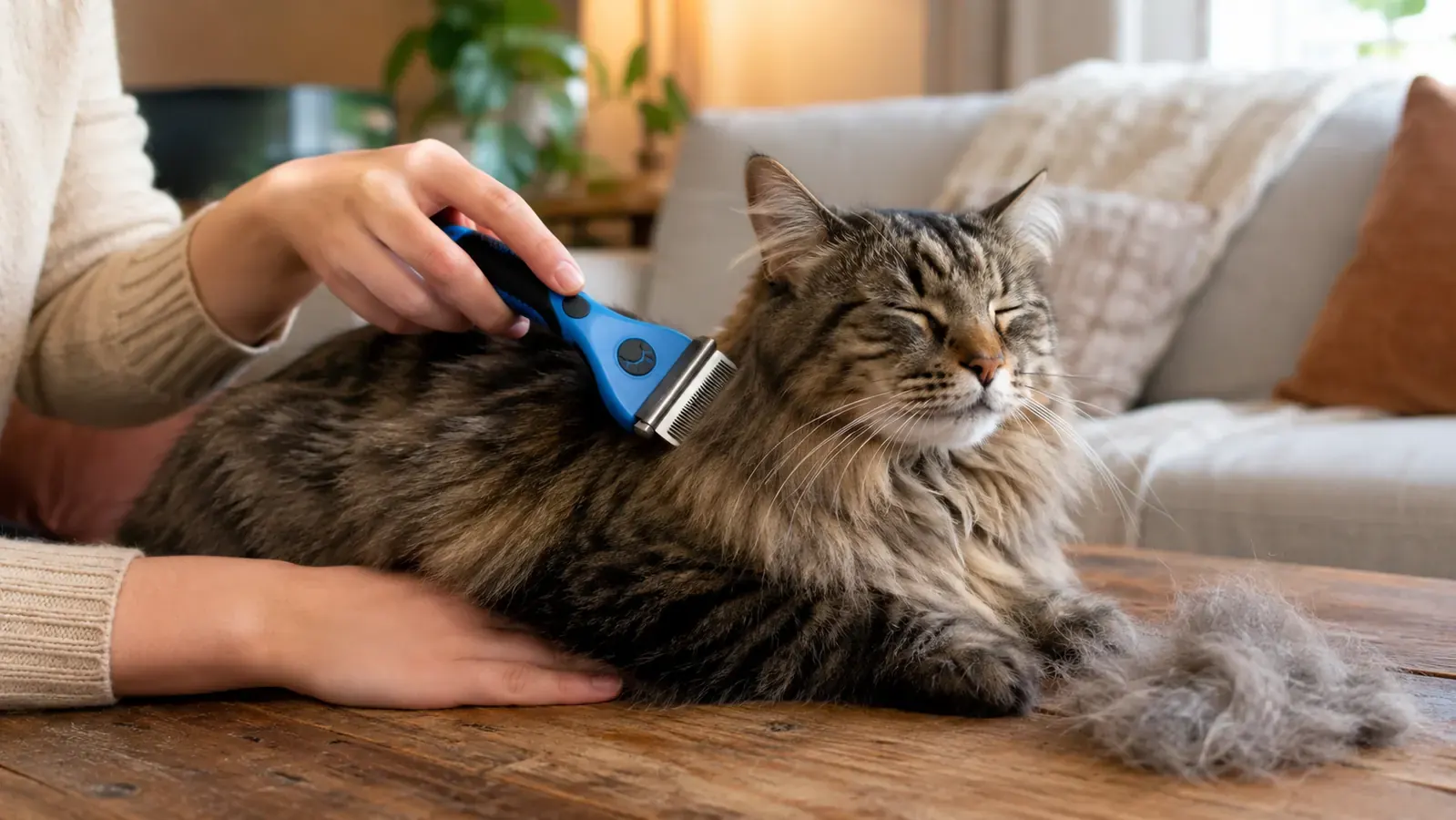
What you actually want is a deshedding rake with metal teeth that reach through to that undercoat. The Maxpower Planet rake I use has an extra-wide, double-sided comb with a gap in the middle of the teeth, which is the detail that matters. The gap keeps the rake from grabbing and yanking full clumps the way a cheap flea comb does, while still pulling the loose dead fur out cleanly. It is one of the least expensive things in my grooming drawer, and it is the one that does real work. I keep a second one in the car for the vet trips, but you only need one.
Step 2: Build a Routine You Can Actually Keep
The biggest mistake I made early on, and I suspect the one most people make, is treating brushing as a special event I did when I remembered. Cats shed in cycles, heaviest in spring as they drop the winter coat and again in fall as they trade it for a thicker one. That loose fur does not wait. If you attack it all at once with a binge session twice a month, you will both be miserable and the couch will still lose.
What works instead is a short, boring routine. For a long-haired cat like Poppy, I brush every other day for about five minutes. For my two short-haired girls, Mabel and Junie, twice a week is plenty. I do it at the same time each day, usually when they are drowsy and relaxed in the evening, and I keep the session short so nobody learns to dread the rake. Five minutes, twice to three times a week, beats one dramatic deep-clean every few weeks every single time. The fur that leaves their coat in small doses never gets the chance to pile up.
I will also tell you the part that surprised me most, because I grew up with dogs and thought I already understood shedding. A dog tends to blow its coat in clear, dramatic seasons and then is largely done. A cat, especially an indoor cat living under steady artificial light and steady heat, sheds in smaller, muddier cycles all year long. That is why the routine has to be a habit and not an appointment. The moment I stopped waiting for the seasons and started treating every-other-day as just what we do, the pile on the floor shrank, and Poppy stopped looking at the rake like it was a betrayal.
Step 3: Brush With the Grain and Let the Coat Guide You
There is a right direction for all of this, and it is simpler than people make it. Work with the growth of the hair, from head toward tail, in slow even strokes. On a long-haired cat you want to follow the natural fall of the coat rather than going against it and hacking through tangles. The Maxpower Planet rake's teeth travel through the undercoat and lift the dead fur out at the root, which is why after a few strokes you will see it coming up in soft sheets instead of the fur just staying put.
Two small things made the difference for me. First, do not press hard. The rake does the work; if I am pushing, I am either scraping skin or just moving fur around. Second, if you hit a mat or tangle on a long-haired cat, do not saw at it. Lift the section and work it gently from the outside edge, or set the rake down and use your fingers to loosen it first. Cats read a yank as pain, and Poppy is the first to tell me when I am being clumsy. When the coat is healthy and brushed regularly, most mats never get a chance to form.
Step 4: Give the Heavy Shedders an Occasional Bath and Out-of-Season Reset
I know the word bath makes some cat people flinch, so let me say it plainly: most cats never need one, and I would not wrestle a cat into a tub on a whim. But a heavy shedder who is blowing her coat hard in the spring or fall is a different case. A warm-water bath once or twice in the middle of that shed cycle does something a brush cannot. It loosens and floats off a surprising amount of dead undercoat at once, and if you brush her as she air dries, you catch the fur as it loosens rather than as it lands on your floor.
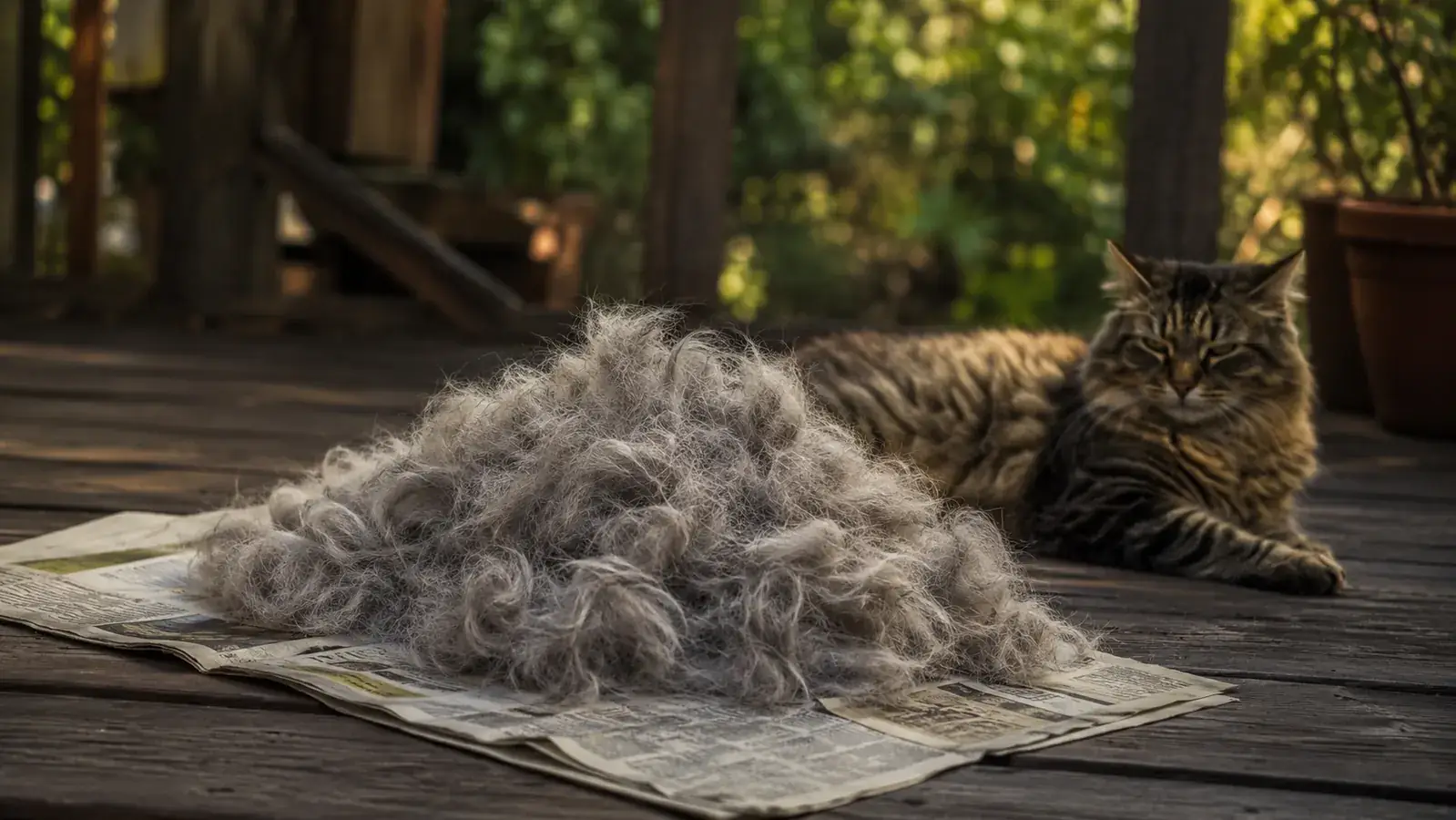
If bathing your cat is not happening, and genuinely no judgment if it is not, the reset that matters is a thorough out-of-season session with the rake. Set out a newspaper, put your cat somewhere she is comfortable, and work her in sections so you can actually see the fur coming out. With Poppy I do this about every six weeks even outside shedding season, and I can absolutely tell the difference. She is an animal with a real coat and real seasons, not a decoration, and treating her grooming like a maintenance job rather than a rushed chore is what keeps the fur contained.
Step 5: Feed the Coat From the Inside, Because Brushing Is Half the Fight
This is the step nobody tells you about, and it is the one that made the biggest visible difference for me. A dull, brittle coat sheds a lot worse than a healthy one. Your cat's skin and fur are built from the food she eats, so the single best thing I do for Poppy's shedding is feed her well. A good quality food with real animal protein keeps the coat naturally glossy, and I add an omega-3 fatty acid supplement to her meals, which supports skin health. It is not magic, and it takes a few weeks to show, but a healthy coat hangs onto its fur better and sheds noticeably less.
Hydration matters too, and this is where I sound like my dog-owner self for a second. Cats are descended from desert animals and were never great about drinking. A dry coat is a shedding coat. Making sure each of my three has easy access to fresh water all day, and wet food mixed into the rotation for the ones who will eat it, keeps their coats from getting that dull, shedding-heavy look. If your cat is a picky drinker, keeping the fresh water flowing matters more than you would think, and it costs you nothing but attention.
There is a bonus to all of this that you will notice before the floor does, and it is the hairballs. A long-haired cat swallows a lot of fur when she grooms herself, and that fur has to go somewhere. By pulling the loose dead undercoat out with the rake before she can lick it off, I cut the hairballs Poppy was hacking up from a few times a week to maybe once a month. It is the least glamorous benefit on this list, but for anyone who has stepped on a wet hairball at 6 a.m., it may be the one you care about most.
What Else Helps
Even with a good routine, a little fur will get away from you, and that is normal and fine. I keep a cheap lint roller by the front door for the ten seconds of touch-up before I head out, and I wash the throw blankets Poppy favors every couple of weeks, which catches a surprising amount of what the brush missed. I also brush her in the same spot every time, over newspaper or on the porch, so the fur never scatters across the whole house. Small containment beats trying to be perfect, and it keeps the routine from feeling like a losing battle.
After eight weeks Poppy's brush went from looking like I had groomed a small animal to pulling just a handful of loose hairs. The fur did not disappear, it just stopped taking over the house.
One honest warning before you go shopping: there are a lot of overpriced shedding gadgets out there, and most of them are gimmicks. You do not need a motorized grooming glove or a special vacuum attachment to fix a shedding problem. You need one good rake like the Maxpower Planet, a rhythm you can keep, and food that treats the coat from the inside. That is the whole plan, and it is the plan that actually works.
Start With the Rake That Actually Reaches the Undercoat
If your current brush is not pulling loose fur out of the coat, it is not doing its job. The extra-wide Maxpower Planet rake is the inexpensive first step that makes the whole routine work.
Amazon Check Today's Price on Amazon →